Alan Reinke recently photographed a beautiful, sharply defined fog bank over the Pacific Ocean. It's our air conditioning, here on the Mendonoma coast.

This morning the fog was heavy and wet, drippy wet. I wish I could send that moistness to the areas of fire, and to those suffering from a terrible heatwave in other parts of the country.

Thanks to Alan for allowing me to share his photo with  you here.

There are many good reasons not to leave a rope, or any kind of line, dangling in a tree or bush. Birds can get entangled. Several weeks ago Gary Hopkins photographed a beautiful Great-horned Owl hanging by a wing in a tree, ensnarled in a rope.
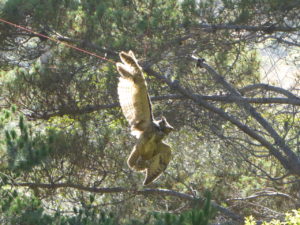
Diane Hichwa tells the story. “Gary Hopkins had family visiting. They saw the owl fly past Friday night. Saturday afternoon as they drove on Moonraker Road on The Sea Ranch they saw a Great-horned Owl caught by a rope in a tree! They got a ladder, gloves, blanket and headed down the steep hill. It took a while to get the rope and the bird down. Then it took a long while to unwrap the multiple wraps of rope around the owl’s wrists.”

Diane [center], Gary Hopkins [front] and Rick Hansen [rear] helped with the rescue. This photo was taken by Bryant Hichwa
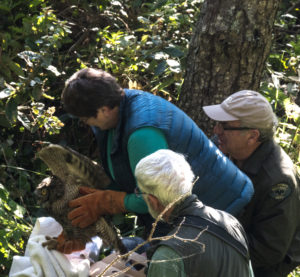
The owl was transported to Bird Rescue in Santa Rosa, where she was described as “feisty.” The theory about the rope is that ropes were being used to pull power lines just below the tree. One obviously was left behind. The area was thoroughly checked to make sure no rope was left behind to endanger wildlife. Thanks to everyone who helped this owl!

Thanks to Gary and Bryant for allowing  me to share their photos with you here.
Maria Bardini-Perkins wrote, “On a walk with a friend we came across a meadow filled with colonies of the beautiful California native Tiger Lily. The number and bright color of them took us by surprise!”

Lilium pardalinum are also called Leopard Lilies. Promise me you will never pick them!

Thanks to Maria for allowing me to share her photo with you here.

Steve wrote, "On a Memorial Day weekend walk at Pelican Bluffs with friends, I encountered this lizard on the trail. They're great photo subjects - they don't move a muscle!”

Steve’s wife, Nancy, told me this type of lizard is often bitten by ticks. There is a protein in the lizard’s blood that cleanses the tick of Lyme disease. They also eat ticks and other invertebrates such as insects and spiders. Perhaps a cure for Lyme disease will come from studying how this lizard is able to neutralize it. Wouldn't that be wonderful?

Thanks to Steve for allowing me to share his photo with you here.

It's already heating up on the Mendonoma Coast. Point Arena puts on their annual fireworks tomorrow night, Saturday, at the Pier. And the parade is Sunday at noon. The weather should be great if you like it warm.

Lynda Opperman and Howard Curtis noticed this tiny nest with two Anna's Hummingbird chicks inside.

This is a very good reason why you shouldn't prune bushes or trees during nesting season! Isn't the nest exquisite? The mother hummer builds it with lichen, moss and spiderwebs. The nest expands as the chicks grow because of the spiderwebs. Good planning, mother hummer!

Some years ago Siegfried Matull photographed an Anna's Hummingbird nest. Here it is with two eggs. The mother has lined the inside of the nest with feathers and other soft materials.

Here the mother is sitting on her eggs.

And here are her two chicks.

This is a wonderful time of year, bursting with new life, here on the Mendonoma coast.

Thanks to Lynda and Siegfried for allowing me to share their photos with you here.