Tag Archives: Humpback Whale

Two weeks ago was a great time for seeing Humpback Whales off the Mendonoma Coast.

Scott and Tree Mercer didn't have any sightings of mother/calf gray whales that week, but they were compensated with humpback sightings. Tree wrote, “Despite some challenging wind and fog conditions, humpback whales continue to be seen along our coast. This week, Scott and I documented 40 sightings  of humpbacks seen at the Point Arena Lighthouse peninsula, Saunders Reef, and at Gerstle Cove. Seven additional humpbacks were seen by Shari Goforth at Ollie’s Straight, Gualala Point Island and off the beach at Gualala Point Regional Park. Many of these humpbacks displayed full and half breaching, tail lobbing, and taking long dives most likely to feed on anchovies.

We have also observed two foraging gray whales swimming both north and south along the peninsula at the Lighthouse. We continue to search for gray whale mothers with their calves which typically can be seen throughout the month of May and even into early June.”

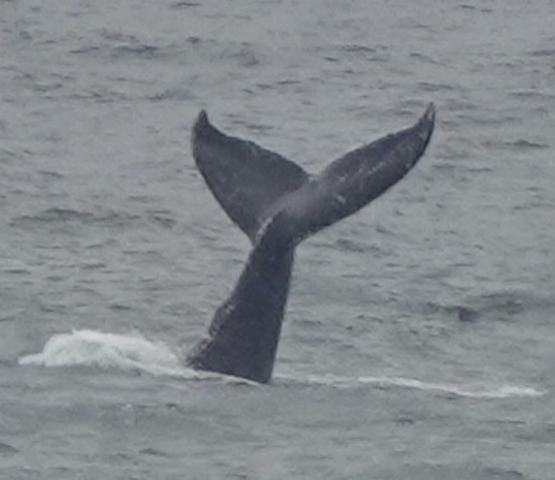
Sara Bogard got a nice photo of a humpback whale tail lobbing while doing her weekly survey of harbor seals off the Point Arena Lighthouse peninsula and surrounding areas.

She spotted 128 harbor seals of which 38 were pups.

Thanks to Sara for allowing me to share her photo with you here and thanks to the Mercers for their report.

Sunny and warm today, but there's a storm coming in tonight - hard to believe!

Pete and Kathie Hayes were thrilled when a  humpback whale began slapping its tail on the surface of the ocean. Pete wrote, “My wife and I have been seeing so many whales from Wild Iris, Sea Ranch, particularly yesterday and today, the 29th and 30th. In addition to spouting, we've seen whales appearing to slap their tails in the water. Often multiple times. First, can you please help us identify what kind of whale this is? And second, can anyone explain why they are doing this?”

Pete sent in a video of the multiple tail slaps, which you can view here.

Humpback whale tail slapping by Peter Hayes

Whale expert, Scott Mercer, confirmed the sighting as humpback whales. I learned as a humpback slaps its tail, the theory is the loud noise causes fish to become frightened, resulting in a tightened school, making it easier for the humpbacks to feed.  It’s also thought to be communication as the loud sound created by the slap can travel long distances underwater. And maybe it’s just fun!

Thanks to Peter for allowing me to share his photo and video with you here.

A few showers this morning, and several rainbows blessed us with their beauty. It's sunny and cool this afternoon. Yesterday's rain was only 0.05 inches at Rick's and my place in Anchor Bay, but in Point Arena Linda Bostwick had 1.10 inches! There were some cells with a LOT of rain in them, while other places only got a splash or two.

2 Comments

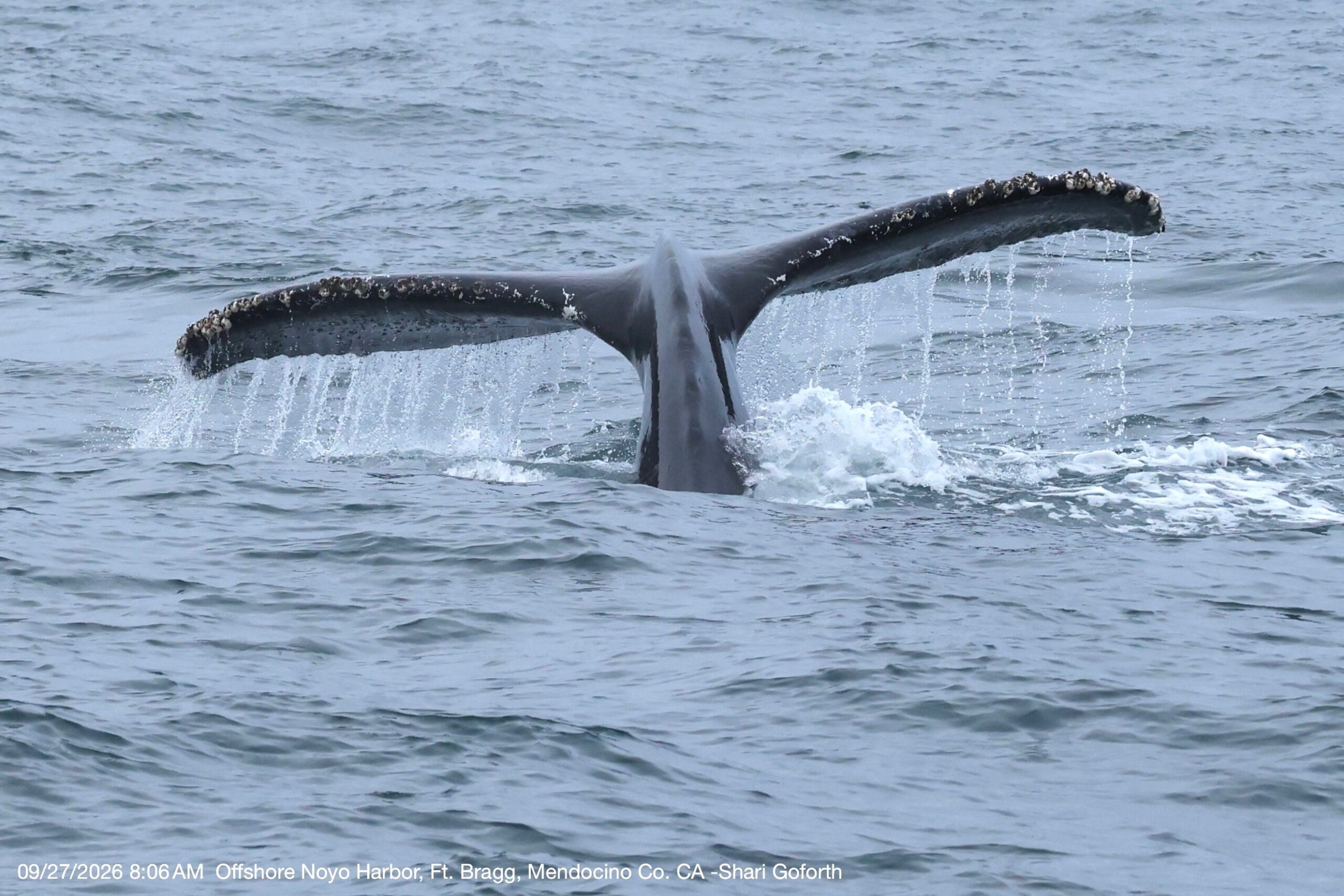
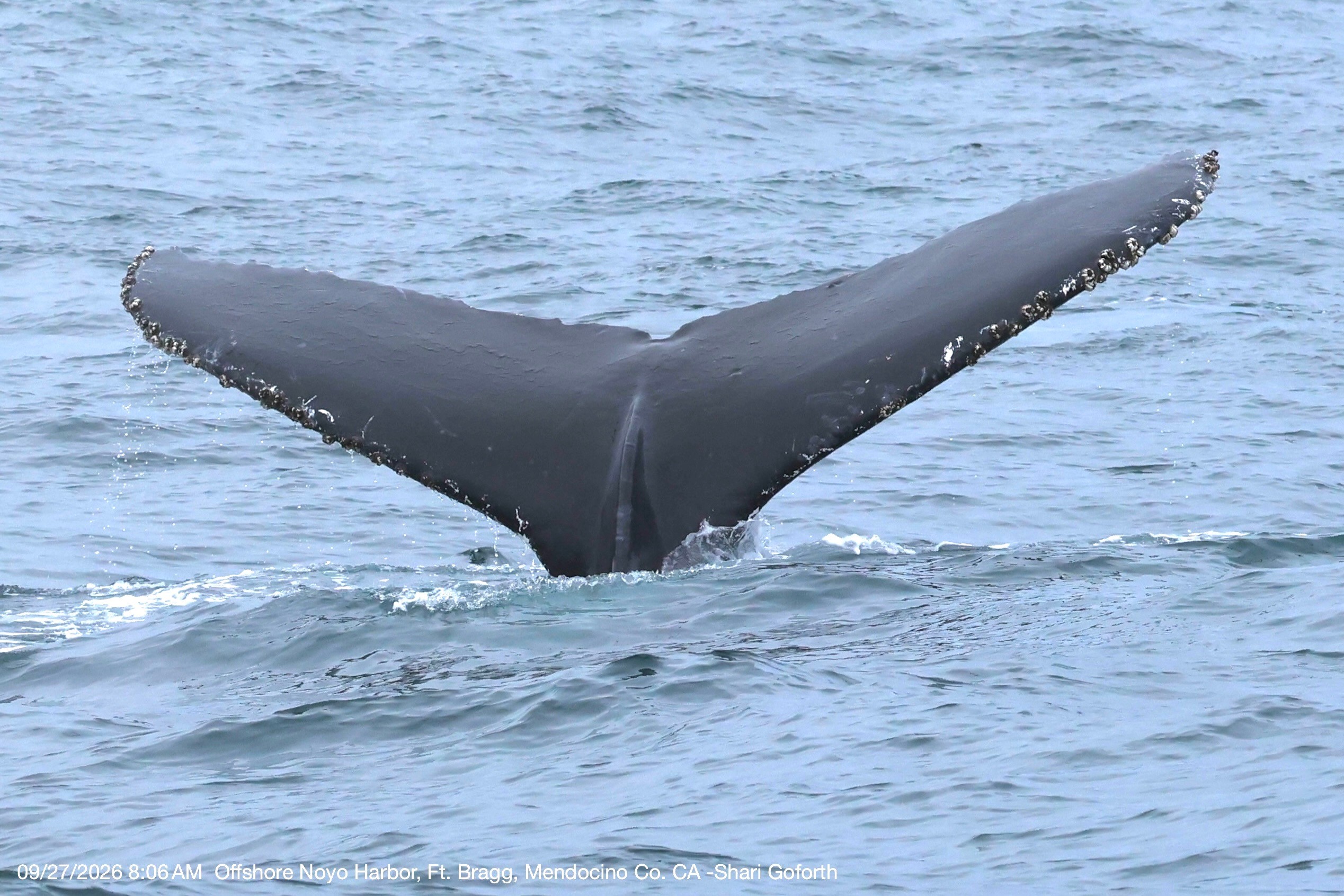
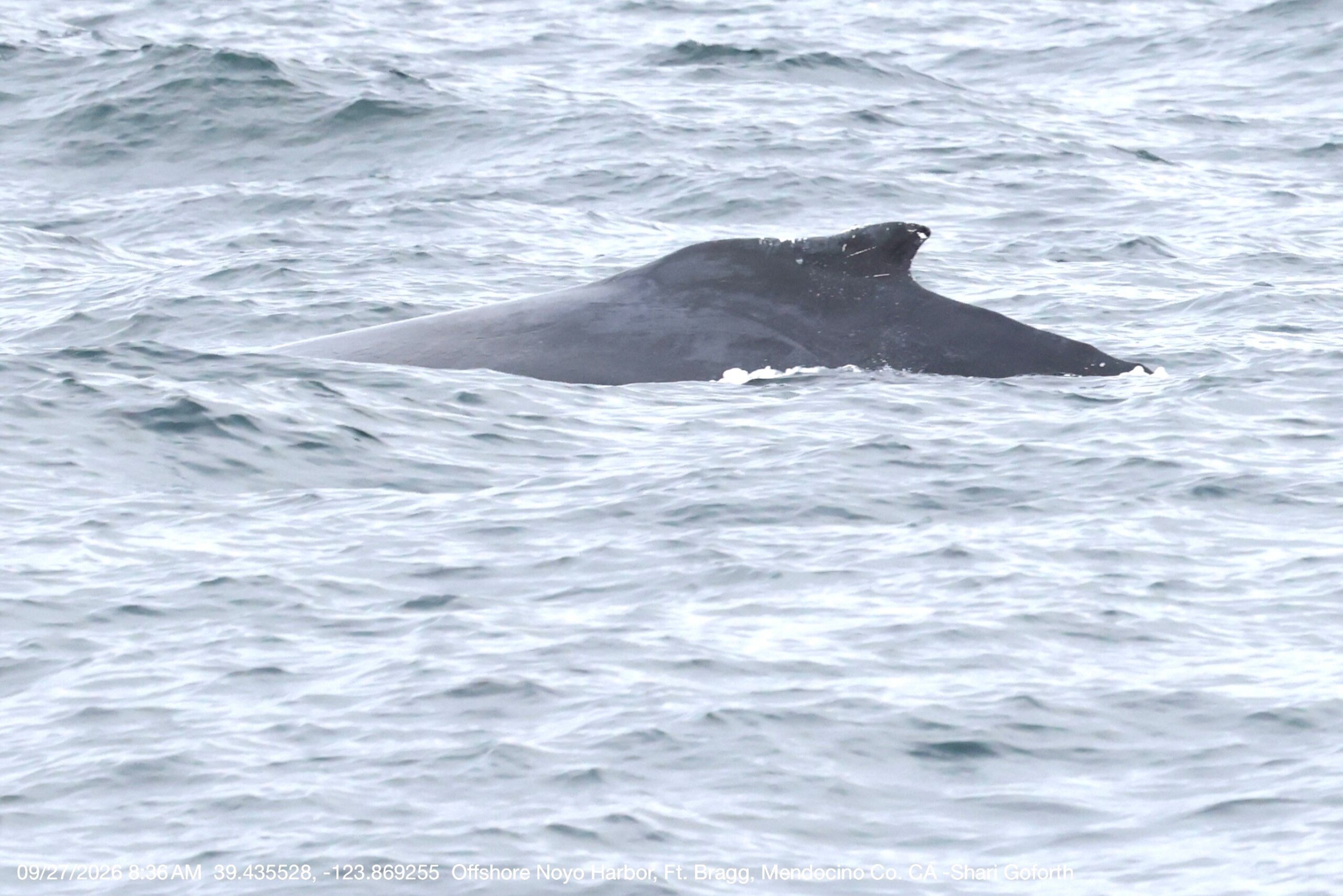
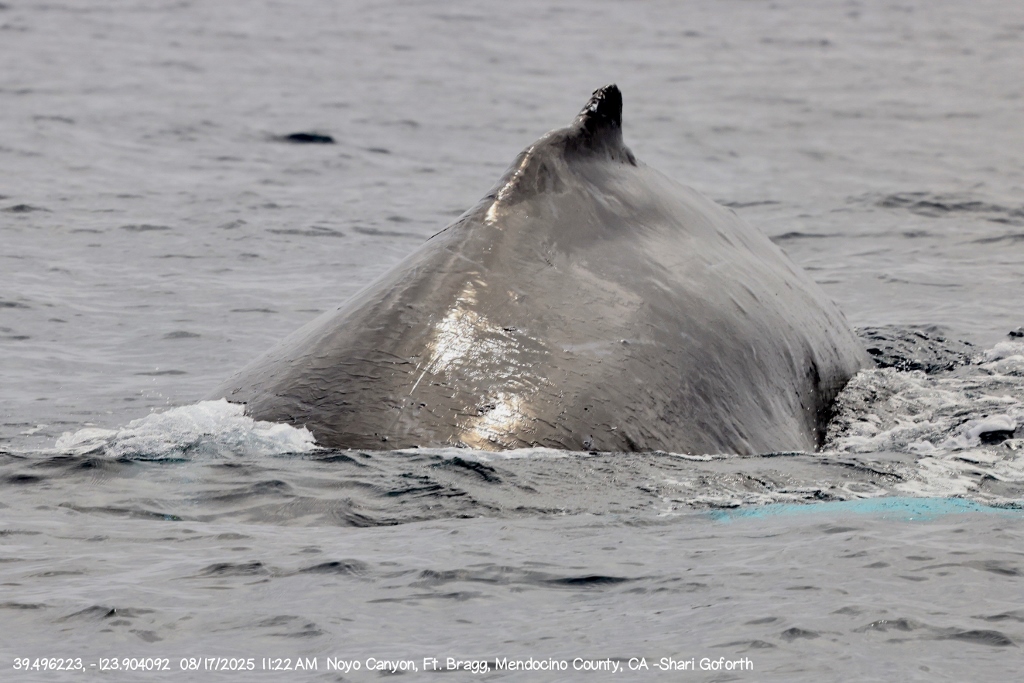
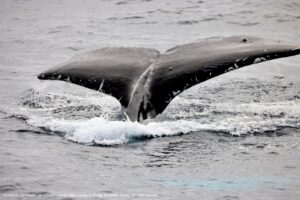
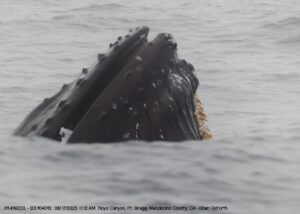
Shari Goforth headed out in two weeks ago on a Saturday for a pelagic trip out of Noyo Harbor on The Kraken along with 24 other seafarers. Many on board were birders, excited to see different kinds of petrels, albatrosses, skua and terns. Shari is mostly on the trip to spot whales. A blue whale was seen and Pacific white-sided dolphins. And humpbacks! Shari wrote, “It was a gray day, so here are a few photos that are not fogged-in. We were about from eight miles from the red and white whistle buoy outside Noyo Harbor when we encountered a group of humpback whales.”
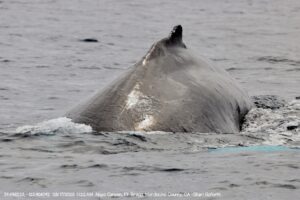
Look at the green light on the water on the lower right. It's the sun reflected on the whale's body that is underwater. Shari says they can often see a whale before it spouts by noting this green reflection.

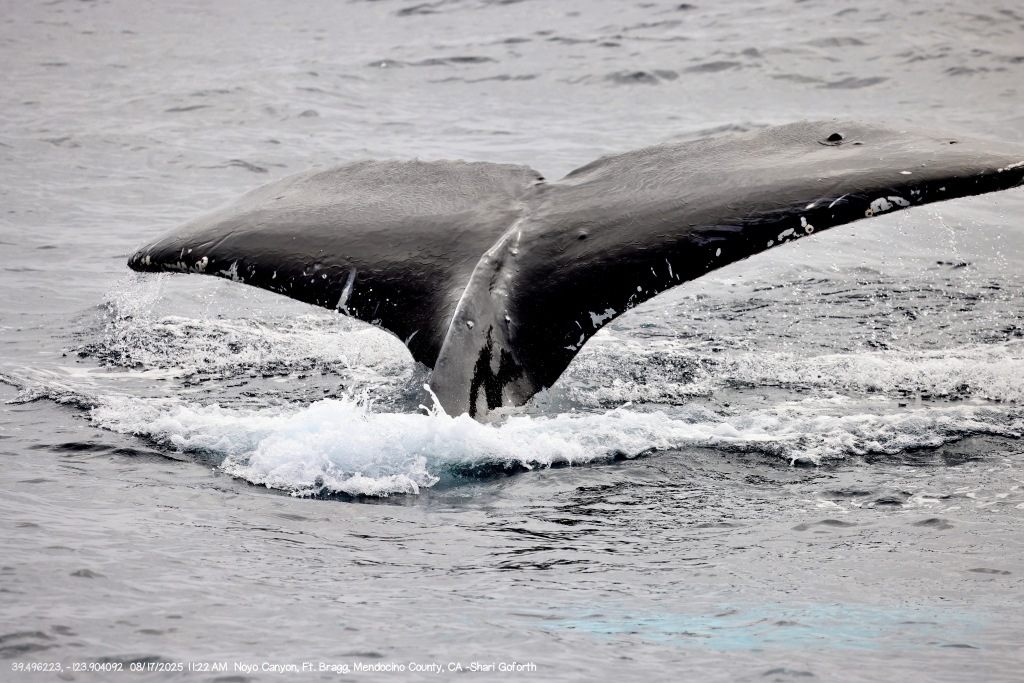
Shari got a clear photo of a distinctive fluke and she sent it in to Happy Whale to see if they had a previous identification of this particular whale. They did. Shari wrote, “That fluke is CRC-20332, Cascadia Research collective’s research number,  no nickname, first recorded off Baja 01-03-2022, the only sighting before our photo record on 08-17-2025."
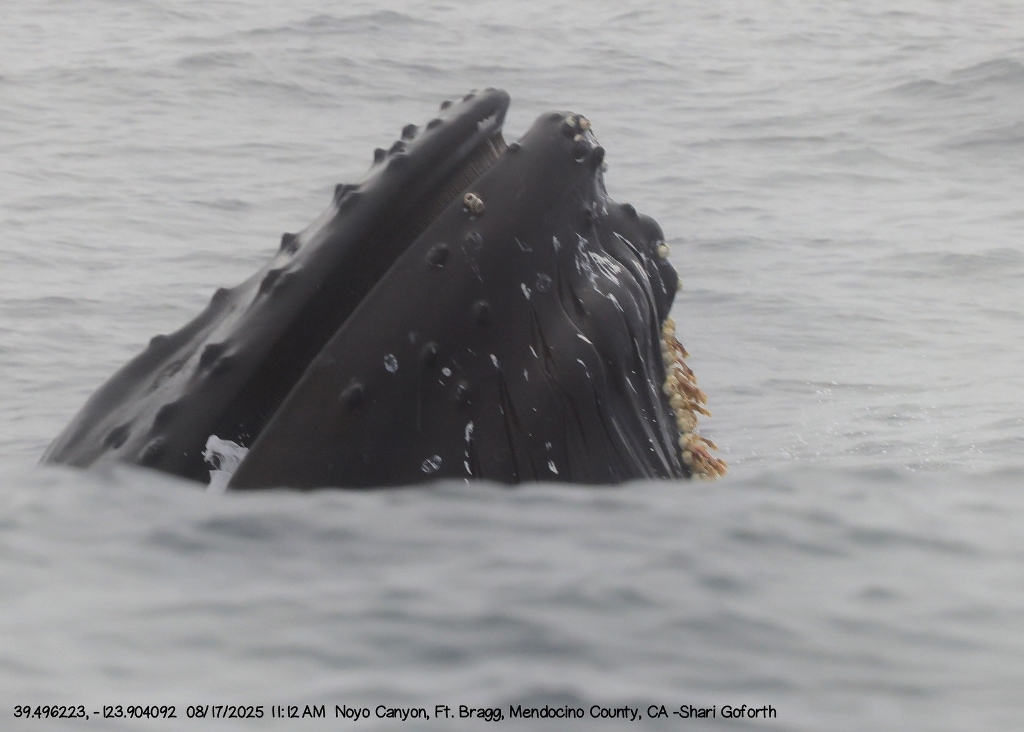
Another photo is of a humpback rostrum showing the mouth nearly closed after a lunge feeding event with one other whale. The barnacles visible on the lower mandible pouch show their exposed cirri, the barnacles’ feeding appendages. Needless to say, it was a great trip!”
Thanks to Shari for allowing me to share her photos with you here. If you'd like to learn more about the pelagic trips out of Noyo Harbor, here is the link: http://noyopelagics.com

To be on their mailing list, you can sign up here: https://groups.io/g/Mendocino-Pelagics

The fog bank is smaller and a ways out over the ocean. Breezy sunny weather happening now!
Humpback Whales, some with their calves, slowly travel northward this time of year in search of food. A few weeks ago, Shari Goforth-Eby found a young Humpback Whale off Saunders Reef.

Shari wrote, "I saw one Humpback close to the reef - it appears to be a sub-adult foraging on bluff side and south side of the reef. This is the second young Humpback Whale seen in our area exhibiting Gray Whale-type behavior in the shallower waters. Humpbacks and Gray Whales are baleen whales; they strain their food through a network of keratin plates similar to hair. But Gray Whales feed from the bottom and get small shrimp up in the kelp. Humpbacks feed on schools of krill and bait fish. It is unusual for us to see Humpbacks in shallow areas for any reason."

Thanks to Shari for allowing me to share her photo with you here.

Yep, the fog rolled in overnight, giving those of us near the ocean a foggy start to our day. Sunlight began to break through around noon in places on this first full day of Summer!


2 Comments

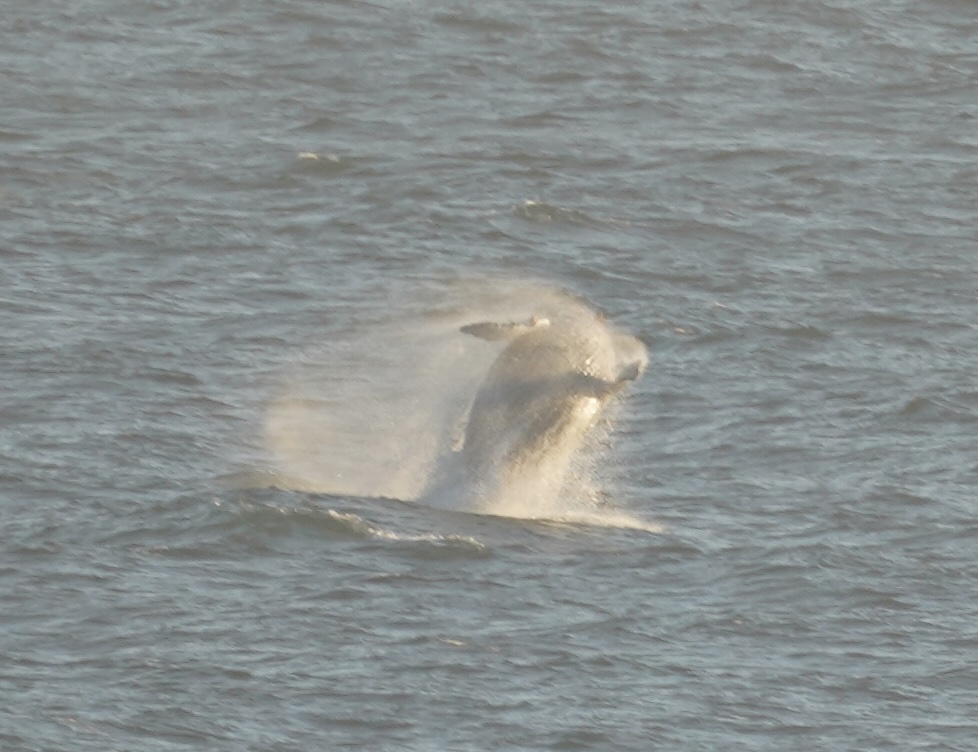
Monday evening Mike Petrich saw a blow, the exhalation of a whale, out on the Pacific Ocean. He had his camera and captured this series of a Humpback Whale breaching, just magnificent!

Scott Mercer was told by a fisherman that anchovies are off the Mendonoma Coast in vast numbers. That fact is going to bring more whales and other marine mammals to our area. Get your binoculars out!

Thanks to Mike for allowing me to share his series of photos with you here.

Fog on the immediate coast, sunny away from the coast - hey, it must be summer!