I have never found one of these beauties. But Chris Pechal found this blooming at The Sea Ranch recently. It's called Pleated Gentian, Gentian affinis.

I shared Chris’ photo with botanist Peter Baye. He confirmed the ID, writing, “Definitely Gentian affinis. That’s an exceptionally pure and large-spotted one. It is distributed right along the immediate coast in well-drained sandy marine terrace soils. There are some old records of it near you in Anchor Bay, and Amy Ruegg reported one from Sea Ranch.” I’ll be looking at my place in Anchor Bay. I have well-drained sandy soil!

Breezy and cooler today, temps in the low 70's.

Michael Reinhart photographed a beautiful...or, should I say, handsome...Wilson's Warbler. The black cap is the most prominent giveaway this is a male.

These small warblers nest on the Mendonoma Coast and to our north. They eat insects, usually found on leaves, though they will catch flies and other flying insects in the air. The numbers of these beautiful birds are in "steep decline," mostly due to habitat loss. The experts say the best thing you can do for them is to plant native plants in your garden.

To hear the sweet call of these birds, here is a link to the Cornell Lab of Ornithology: https://www.allaboutbirds.org/guide/Wilsons_Warbler/sounds

Thanks to Mike for allowing me to share his photo with you here.

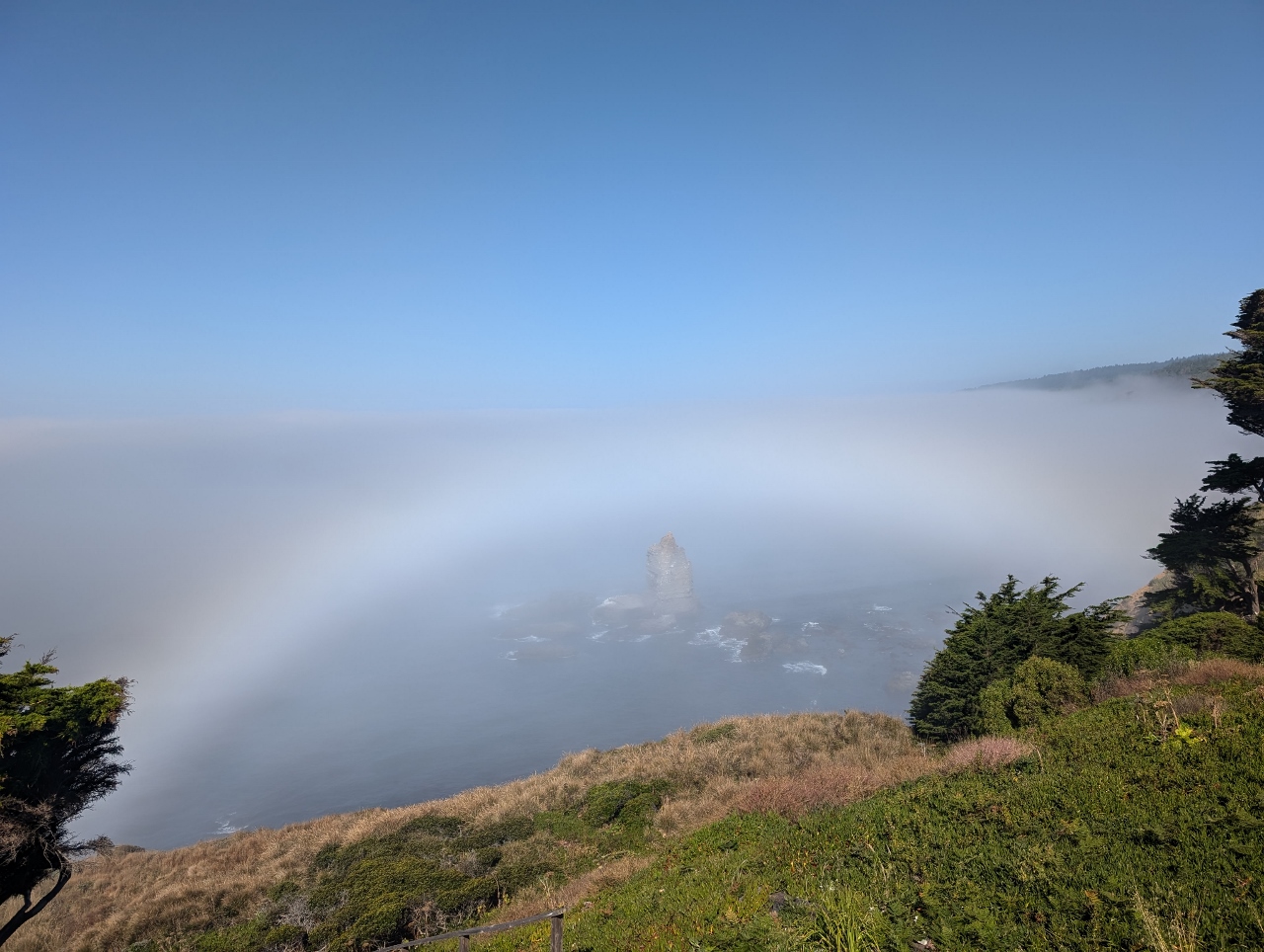
Dense fog this morning has cleared away to brilliant sunshine. Mild temps. Lots of visitors to the coast now!

Karen Wilkinson found a unique group of Coast Lilies. Lilium maritimum is only found in California north of San Francisco. A typical plant has as many as 13 nodding blossoms. But look what Karen discovered. She wrote, “I went to check in on Gentian on the ridge this morning and came across the most prolific Coast Lily plant I've ever seen.  21 open flowers, nine seed pods, and six buds that hadn't opened yet.” That would total 36 blossoms.

I sent Karen’s photo to botanist Peter Baye, and this was something he hadn’t seen before. He wrote, “That's not only exceptional, it's due to a deformation of the shoot tip during early flower bud development. Notice the flattening of the stem near the top? It's a fasciation. In this case, the ‘deformation’ of the shoot tip, or somatic mutation, doesn't affect the individual flowers. This is the only example of this I've ever seen in any native lily! Excellent find. Thanks! And thanks to Karen Wilkinson.”

Thanks to Karen for allowing me to share her photo with  you here, and for showing us something so unusual!

Not much fog this morning and ironically it's cooler, temps in the 60's. There are passing clouds which always adds interest to sky watching!

Cindy Morey has a kind heart. She wrote, “Greetings from Irish beach. I saved a family of Wild Turkeys yesterday near Manchester. I stopped to take a photo just as they crossed the road and was able to stop traffic in both directions so they were safe. I call this photo ‘Follow the Yellow Brick Road.’”

I count eight chicks or poults in Cindy’s photo, along with the mother. Nice work, Cindy!

Thanks to Cindy for allowing me to share her photo with you here.

Once again it was very foggy this morning, with brilliant sunshine in the afternoon. Looking down at Anchor Bay with a friend this afternoon was something special. The blue water sparkled in the afternoon sun, beckoning you to come and play.

We know several Black Bears live on the Mendonoma Coast. The proliferation of motion detector cameras/wildlife cameras gives us a peek at their nocturnal visits - this visit was on July 24, 2024.

Pat Whelan sent in two videos for us to enjoy. Once the bear disappears in the video, you can stop watching. I need to learn how to crop a video - soon!

Bear visit 7.24.24 courtesy of Pat Whelan

Bear leaving 7.24.24 courtesy of Pat Whelan

This sure looks like a healthy bear! Thanks to Pat for allowing me to share her videos with  you here.

Same weather pattern, fog in the morning and mild temps in the afternoon.